Quickstart
Estimating activities of fixed signatures
To inject fixed signature definitions into the probabilistic model, we use pymc3’s “observed variable” functionality. Once observed, the signature definitions will not be updated during inference.
[23]:
import pymc3 as pm
import arviz as az
import numpy as np
import pandas as pd
import damuta as da
import seaborn as sns
import matplotlib.pyplot as plt
[24]:
# Load data for 100 patients
counts = pd.read_csv('example_data/pcawg_counts.csv', index_col=0).head(100)
annotation = pd.read_csv('example_data/pcawg_cancer_types.csv', index_col=0).head(100)
pcawg = da.DataSet(counts, annotation)
To fix the damage signatures, we will observe phi. To fix the misrepair signatures, we will observe eta in the C context, and in the T context.
[25]:
damuta_sigs = da.SignatureSet.from_damage_misrepair(
    pd.read_csv('example_data/damage_signatures.csv', index_col=0),
    pd.read_csv('example_data/misrepair_signatures.csv', index_col=0))
[5]:
ht_lda = da.models.HierarchicalTandemLda(pcawg, type_col = 'pcawg_class',
                                         phi_obs= damuta_sigs.damage_signatures.to_numpy(),
                                         etaC_obs= damuta_sigs.misrepair_signatures[['C>A', 'C>G', 'C>T']].to_numpy(),
                                         etaT_obs= damuta_sigs.misrepair_signatures[['T>A', 'T>C', 'T>G']].to_numpy())

ht_lda._build_model(**ht_lda._model_kwargs)
[6]:
ht_lda.fit(n=10000)
Finished [100%]: Average Loss = 4.641e+05
[6]:
<damuta.models.HierarchicalTandemLda at 0x2b721300bf70>
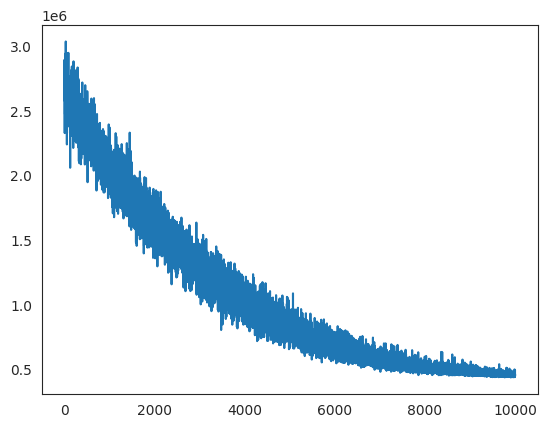
Check for nice convergence
[10]:
plt.plot(ht_lda.approx.hist)
[10]:
[<matplotlib.lines.Line2D at 0x2b723e9e7f40>]
Under the hood
Signature activities can be estimated from the product of the damage activities (\(\theta\)) and the association matrix (\(A\)). We call this product \(W\), where for draw \(d\) from the posterior, genome \(g\), damage signature \(i\) and misrepair signature \(j\), \(W_{dgij} = \theta_{dgi} A_{dgij}\). Because of the compositional properties of signature activities, \(\Sigma_{i}\theta_{dgi} = 1\) and \(\Sigma_{j}A_{dgij} = 1\). This means we can conveinently marginalize over the damage, and misrepair axes of \(W\) to get damage activities \(\theta_{dgi} = \Sigma_{j}W_{dgij}\) and misrepair activities \(\Gamma_{gdj} = \Sigma_{i}W_{dgij}\)
Let’s see this in code:
[11]:
trace = ht_lda.approx.sample(10)
trace
[11]:
<MultiTrace: 1 chains, 10 iterations, 17 variables>
[12]:
print("theta shape: ", trace.theta.shape)
print("A shape: ", trace.A.shape)

# reshape A for broadcasting
# nb. only necssary for hierarchical model
A = np.moveaxis(trace.A,1,2)
print("A reshaped: ", A.shape)

# compute W
W = (trace.theta[:,:,:,None]*A)
print("W shape: ", W.shape)

# check that W sums to theta over the misrepair axis
print("W correctly marginalizes to theta: ", np.allclose(W.sum(-1), trace.theta))

theta = W.sum(-1)
gamma = W.sum(-2)

# display mean over 10 posterior samples
display(pd.DataFrame(theta.mean(0)))
display(pd.DataFrame(gamma.mean(0)))
theta shape:  (10, 100, 18)
A shape:  (10, 18, 100, 6)
A reshaped:  (10, 100, 18, 6)
W shape:  (10, 100, 18, 6)
W correctly marginalizes to theta:  True
| 0 | 1 | 2 | 3 | 4 | 5 | 6 | 7 | 8 | 9 | 10 | 11 | 12 | 13 | 14 | 15 | 16 | 17 | |
|---|---|---|---|---|---|---|---|---|---|---|---|---|---|---|---|---|---|---|
| 0 | 0.018148 | 0.041422 | 0.014217 | 0.052663 | 0.049612 | 0.058811 | 0.071537 | 0.130497 | 0.066573 | 0.035261 | 0.021667 | 0.124121 | 0.016808 | 0.030907 | 0.047377 | 0.071972 | 0.010440 | 0.137968 |
| 1 | 0.196696 | 0.004420 | 0.018841 | 0.013270 | 0.016926 | 0.023671 | 0.162195 | 0.036593 | 0.076675 | 0.004726 | 0.011317 | 0.014630 | 0.046820 | 0.001704 | 0.091335 | 0.083935 | 0.110214 | 0.086030 |
| 2 | 0.027179 | 0.006244 | 0.020942 | 0.027659 | 0.007212 | 0.034248 | 0.241564 | 0.087762 | 0.029229 | 0.004069 | 0.006210 | 0.070710 | 0.011210 | 0.035043 | 0.059892 | 0.302042 | 0.011307 | 0.017476 |
| 3 | 0.162715 | 0.004495 | 0.024484 | 0.009229 | 0.004569 | 0.041733 | 0.107043 | 0.059714 | 0.041113 | 0.005306 | 0.005099 | 0.077870 | 0.032388 | 0.010351 | 0.045068 | 0.151163 | 0.194221 | 0.023440 |
| 4 | 0.048726 | 0.018671 | 0.032167 | 0.007728 | 0.022793 | 0.087195 | 0.101831 | 0.098192 | 0.027594 | 0.013096 | 0.010840 | 0.159202 | 0.026011 | 0.014519 | 0.140401 | 0.085658 | 0.087918 | 0.017457 |
| ... | ... | ... | ... | ... | ... | ... | ... | ... | ... | ... | ... | ... | ... | ... | ... | ... | ... | ... |
| 95 | 0.023237 | 0.019154 | 0.055715 | 0.034148 | 0.021770 | 0.023628 | 0.105320 | 0.071424 | 0.036490 | 0.016433 | 0.017406 | 0.146123 | 0.033986 | 0.041399 | 0.088043 | 0.140026 | 0.047384 | 0.078316 |
| 96 | 0.093214 | 0.020699 | 0.045064 | 0.006078 | 0.028922 | 0.009975 | 0.060595 | 0.115997 | 0.037020 | 0.019665 | 0.025236 | 0.122353 | 0.013375 | 0.007978 | 0.087475 | 0.055401 | 0.183467 | 0.067485 |
| 97 | 0.076210 | 0.067483 | 0.022933 | 0.066986 | 0.074895 | 0.005201 | 0.042560 | 0.062713 | 0.028507 | 0.047743 | 0.024556 | 0.085347 | 0.026325 | 0.074539 | 0.064278 | 0.060788 | 0.119847 | 0.049088 |
| 98 | 0.003044 | 0.548510 | 0.011509 | 0.002059 | 0.162906 | 0.002314 | 0.001786 | 0.002327 | 0.002376 | 0.233313 | 0.011635 | 0.002660 | 0.001525 | 0.001529 | 0.004957 | 0.002173 | 0.003206 | 0.002169 |
| 99 | 0.005570 | 0.034685 | 0.004559 | 0.012614 | 0.019075 | 0.003656 | 0.007450 | 0.003930 | 0.007216 | 0.089470 | 0.504362 | 0.004362 | 0.238739 | 0.034096 | 0.004049 | 0.015485 | 0.006049 | 0.004633 |
100 rows × 18 columns
| 0 | 1 | 2 | 3 | 4 | 5 | |
|---|---|---|---|---|---|---|
| 0 | 0.119163 | 0.076473 | 0.033622 | 0.310843 | 0.269885 | 0.190014 |
| 1 | 0.140634 | 0.207480 | 0.173554 | 0.163602 | 0.179140 | 0.135590 |
| 2 | 0.054899 | 0.075041 | 0.357446 | 0.180587 | 0.311875 | 0.020151 |
| 3 | 0.145366 | 0.079770 | 0.395346 | 0.118004 | 0.064376 | 0.197138 |
| 4 | 0.169410 | 0.085609 | 0.276751 | 0.183347 | 0.103106 | 0.181778 |
| ... | ... | ... | ... | ... | ... | ... |
| 95 | 0.096294 | 0.147463 | 0.156497 | 0.402184 | 0.147838 | 0.049724 |
| 96 | 0.195606 | 0.115633 | 0.135081 | 0.174319 | 0.179204 | 0.200157 |
| 97 | 0.144579 | 0.157569 | 0.080419 | 0.222177 | 0.083163 | 0.312092 |
| 98 | 0.039981 | 0.020032 | 0.152037 | 0.574859 | 0.018432 | 0.194659 |
| 99 | 0.014965 | 0.869613 | 0.036159 | 0.010102 | 0.051987 | 0.017174 |
100 rows × 6 columns
This functionality is implemented in the TandemLDA class as the convience method get_estimated_activities_DataFrame() which also adds back the sample index and turns it into a data frame. You could equally run this several times to get multiple posterior samples.
To get the estimated activities for the signatures we provided:
[13]:
theta_df, gamma_df = ht_lda.get_estimated_activities_DataFrame()
display(theta_df)
display(gamma_df)
| D1 | D2 | D3 | D4 | D5 | D6 | D7 | D8 | D9 | D10 | D11 | D12 | D13 | D14 | D15 | D16 | D17 | D18 | |
|---|---|---|---|---|---|---|---|---|---|---|---|---|---|---|---|---|---|---|
| 0009b464-b376-4fbc-8a56-da538269a02f | 0.023905 | 0.042144 | 0.012821 | 0.067622 | 0.056636 | 0.052268 | 0.082317 | 0.125302 | 0.062317 | 0.015641 | 0.014897 | 0.094237 | 0.012628 | 0.026428 | 0.068918 | 0.082709 | 0.005059 | 0.154153 |
| 003819bc-c415-4e76-887c-931d60ed39e7 | 0.342639 | 0.000648 | 0.000514 | 0.006578 | 0.001124 | 0.028850 | 0.302648 | 0.020001 | 0.009185 | 0.001387 | 0.004508 | 0.002299 | 0.018233 | 0.000272 | 0.052665 | 0.128304 | 0.069978 | 0.010169 |
| 0040b1b6-b07a-4b6e-90ef-133523eaf412 | 0.023239 | 0.011639 | 0.034848 | 0.020823 | 0.007424 | 0.042319 | 0.187420 | 0.131227 | 0.031996 | 0.009143 | 0.002698 | 0.094749 | 0.015183 | 0.038535 | 0.138407 | 0.188625 | 0.009798 | 0.011924 |
| 00493087-9d9d-40ca-86d5-936f1b951c93 | 0.101447 | 0.008213 | 0.013212 | 0.010309 | 0.005631 | 0.054491 | 0.121498 | 0.051175 | 0.032020 | 0.009884 | 0.003356 | 0.122218 | 0.036383 | 0.009040 | 0.046290 | 0.121395 | 0.216920 | 0.036517 |
| 00508f2b-36bf-44fc-b66b-97e1f3e40bfa | 0.076686 | 0.015870 | 0.031908 | 0.005782 | 0.053613 | 0.040126 | 0.136935 | 0.066822 | 0.037307 | 0.015242 | 0.006176 | 0.096585 | 0.024535 | 0.010237 | 0.201561 | 0.077706 | 0.076108 | 0.026801 |
| ... | ... | ... | ... | ... | ... | ... | ... | ... | ... | ... | ... | ... | ... | ... | ... | ... | ... | ... |
| 09508a0d-ebe0-4fa1-b7b2-1710814181cd | 0.014024 | 0.011455 | 0.042805 | 0.025631 | 0.024104 | 0.018295 | 0.159575 | 0.060968 | 0.041322 | 0.016498 | 0.014966 | 0.119394 | 0.034835 | 0.045682 | 0.144392 | 0.098213 | 0.044423 | 0.083417 |
| 09537dce-c797-4b60-962a-d4c3cd6ab00a | 0.058662 | 0.027545 | 0.069911 | 0.006142 | 0.014077 | 0.013516 | 0.040982 | 0.075351 | 0.033984 | 0.012531 | 0.020908 | 0.086793 | 0.035255 | 0.010054 | 0.047830 | 0.056556 | 0.313982 | 0.075921 |
| 0972bfcf-c6c6-48cc-b820-cdfa6279a4f3 | 0.102685 | 0.088997 | 0.027429 | 0.055779 | 0.096025 | 0.006440 | 0.027940 | 0.047849 | 0.024664 | 0.042652 | 0.018933 | 0.084635 | 0.031575 | 0.085959 | 0.042514 | 0.057240 | 0.102292 | 0.056391 |
| 097a7d36-905b-72be-e050-11ac0d482c9a | 0.002253 | 0.502181 | 0.007545 | 0.003651 | 0.146801 | 0.002077 | 0.002475 | 0.002219 | 0.003480 | 0.302682 | 0.007014 | 0.001481 | 0.001848 | 0.001913 | 0.004758 | 0.001927 | 0.002163 | 0.003533 |
| 0980e7fd-051d-45e9-9ca6-2baf073da4e8 | 0.007027 | 0.029439 | 0.003883 | 0.008763 | 0.010373 | 0.004535 | 0.012142 | 0.005621 | 0.005090 | 0.055001 | 0.486708 | 0.006488 | 0.287687 | 0.055831 | 0.004111 | 0.008387 | 0.005773 | 0.003141 |
100 rows × 18 columns
| M1 | M2 | M3 | M4 | M5 | M6 | |
|---|---|---|---|---|---|---|
| 0009b464-b376-4fbc-8a56-da538269a02f | 0.216004 | 0.073933 | 0.029688 | 0.213874 | 0.283196 | 0.183304 |
| 003819bc-c415-4e76-887c-931d60ed39e7 | 0.106277 | 0.192278 | 0.297297 | 0.079554 | 0.190696 | 0.133898 |
| 0040b1b6-b07a-4b6e-90ef-133523eaf412 | 0.057356 | 0.082956 | 0.455159 | 0.125351 | 0.258156 | 0.021023 |
| 00493087-9d9d-40ca-86d5-936f1b951c93 | 0.116519 | 0.084419 | 0.374920 | 0.138902 | 0.057322 | 0.227917 |
| 00508f2b-36bf-44fc-b66b-97e1f3e40bfa | 0.184631 | 0.112263 | 0.333812 | 0.143893 | 0.069998 | 0.155402 |
| ... | ... | ... | ... | ... | ... | ... |
| 09508a0d-ebe0-4fa1-b7b2-1710814181cd | 0.102007 | 0.172737 | 0.135884 | 0.403288 | 0.128281 | 0.057803 |
| 09537dce-c797-4b60-962a-d4c3cd6ab00a | 0.221085 | 0.090471 | 0.089220 | 0.152718 | 0.224753 | 0.221753 |
| 0972bfcf-c6c6-48cc-b820-cdfa6279a4f3 | 0.140435 | 0.180135 | 0.082728 | 0.243320 | 0.092420 | 0.260961 |
| 097a7d36-905b-72be-e050-11ac0d482c9a | 0.034730 | 0.015996 | 0.110241 | 0.587700 | 0.017674 | 0.233658 |
| 0980e7fd-051d-45e9-9ca6-2baf073da4e8 | 0.014682 | 0.856701 | 0.041231 | 0.010088 | 0.062320 | 0.014977 |
100 rows × 6 columns
The DAMUTA model classes wrap pymc3 - we just saw how to sample a MultiTrace from the posterior, and we can also turn this into arviz InferenceData
[14]:
idata = az.from_pymc3(trace, model = ht_lda.model)
[15]:
idata
[15]:
-
<xarray.Dataset> Dimensions: (chain: 1, draw: 10, phi_dim_0: 18, phi_dim_1: 32, gamma_theta_dim_0: 100, gamma_theta_dim_1: 18, theta_dim_0: 100, theta_dim_1: 18, a_t_dim_0: 24, a_t_dim_1: 6, b_t_dim_0: 24, b_t_dim_1: 6, gamma_dim_0: 100, gamma_dim_1: 6, gamma_A_dim_0: 18, gamma_A_dim_1: 100, gamma_A_dim_2: 6, A_dim_0: 18, A_dim_1: 100, A_dim_2: 6, etaC_dim_0: 6, etaC_dim_1: 3, etaT_dim_0: 6, etaT_dim_1: 3, eta_dim_0: 6, eta_dim_1: 2, eta_dim_2: 3, B_dim_0: 100, B_dim_1: 96) Coordinates: (12/29) * chain (chain) int64 0 * draw (draw) int64 0 1 2 3 4 5 6 7 8 9 * phi_dim_0 (phi_dim_0) int64 0 1 2 3 4 5 6 ... 11 12 13 14 15 16 17 * phi_dim_1 (phi_dim_1) int64 0 1 2 3 4 5 6 ... 25 26 27 28 29 30 31 * gamma_theta_dim_0 (gamma_theta_dim_0) int64 0 1 2 3 4 5 ... 95 96 97 98 99 * gamma_theta_dim_1 (gamma_theta_dim_1) int64 0 1 2 3 4 5 ... 13 14 15 16 17 ... ... * etaT_dim_1 (etaT_dim_1) int64 0 1 2 * eta_dim_0 (eta_dim_0) int64 0 1 2 3 4 5 * eta_dim_1 (eta_dim_1) int64 0 1 * eta_dim_2 (eta_dim_2) int64 0 1 2 * B_dim_0 (B_dim_0) int64 0 1 2 3 4 5 6 7 ... 93 94 95 96 97 98 99 * B_dim_1 (B_dim_1) int64 0 1 2 3 4 5 6 7 ... 89 90 91 92 93 94 95 Data variables: phi (chain, draw, phi_dim_0, phi_dim_1) float64 0.06077 ..... gamma_theta (chain, draw, gamma_theta_dim_0, gamma_theta_dim_1) float64 ... theta (chain, draw, theta_dim_0, theta_dim_1) float64 0.0216... a_t (chain, draw, a_t_dim_0, a_t_dim_1) float64 0.8029 ...... b_t (chain, draw, b_t_dim_0, b_t_dim_1) float64 0.6473 ...... gamma (chain, draw, gamma_dim_0, gamma_dim_1) float64 0.9665... gamma_A (chain, draw, gamma_A_dim_0, gamma_A_dim_1, gamma_A_dim_2) float64 ... A (chain, draw, A_dim_0, A_dim_1, A_dim_2) float64 0.091... etaC (chain, draw, etaC_dim_0, etaC_dim_1) float64 0.311 ..... etaT (chain, draw, etaT_dim_0, etaT_dim_1) float64 0.3554 .... eta (chain, draw, eta_dim_0, eta_dim_1, eta_dim_2) float64 ... B (chain, draw, B_dim_0, B_dim_1) float64 0.02305 ... 0.... Attributes: created_at: 2025-06-22T21:21:20.948897 arviz_version: 0.12.0 inference_library: pymc3 inference_library_version: 3.11.2 -
<xarray.Dataset> Dimensions: (chain: 1, draw: 10, gamma_phi_dim_0: 18, gamma_phi_dim_1: 32, gamma_etaC_dim_0: 6, gamma_etaC_dim_1: 3, gamma_etaT_dim_0: 6, gamma_etaT_dim_1: 3, corpus_dim_0: 100, corpus_dim_1: 1) Coordinates: * chain (chain) int64 0 * draw (draw) int64 0 1 2 3 4 5 6 7 8 9 * gamma_phi_dim_0 (gamma_phi_dim_0) int64 0 1 2 3 4 5 ... 12 13 14 15 16 17 * gamma_phi_dim_1 (gamma_phi_dim_1) int64 0 1 2 3 4 5 ... 26 27 28 29 30 31 * gamma_etaC_dim_0 (gamma_etaC_dim_0) int64 0 1 2 3 4 5 * gamma_etaC_dim_1 (gamma_etaC_dim_1) int64 0 1 2 * gamma_etaT_dim_0 (gamma_etaT_dim_0) int64 0 1 2 3 4 5 * gamma_etaT_dim_1 (gamma_etaT_dim_1) int64 0 1 2 * corpus_dim_0 (corpus_dim_0) int64 0 1 2 3 4 5 6 ... 94 95 96 97 98 99 * corpus_dim_1 (corpus_dim_1) int64 0 Data variables: gamma_phi (chain, draw, gamma_phi_dim_0, gamma_phi_dim_1) float64 ... gamma_etaC (chain, draw, gamma_etaC_dim_0, gamma_etaC_dim_1) float64 ... gamma_etaT (chain, draw, gamma_etaT_dim_0, gamma_etaT_dim_1) float64 ... corpus (chain, draw, corpus_dim_0, corpus_dim_1) float64 -1.67... Attributes: created_at: 2025-06-22T21:21:21.335895 arviz_version: 0.12.0 inference_library: pymc3 inference_library_version: 3.11.2 -
<xarray.Dataset> Dimensions: (gamma_phi_dim_0: 18, gamma_phi_dim_1: 32, gamma_etaC_dim_0: 6, gamma_etaC_dim_1: 3, gamma_etaT_dim_0: 6, gamma_etaT_dim_1: 3, corpus_dim_0: 100, corpus_dim_1: 96) Coordinates: * gamma_phi_dim_0 (gamma_phi_dim_0) int64 0 1 2 3 4 5 ... 12 13 14 15 16 17 * gamma_phi_dim_1 (gamma_phi_dim_1) int64 0 1 2 3 4 5 ... 26 27 28 29 30 31 * gamma_etaC_dim_0 (gamma_etaC_dim_0) int64 0 1 2 3 4 5 * gamma_etaC_dim_1 (gamma_etaC_dim_1) int64 0 1 2 * gamma_etaT_dim_0 (gamma_etaT_dim_0) int64 0 1 2 3 4 5 * gamma_etaT_dim_1 (gamma_etaT_dim_1) int64 0 1 2 * corpus_dim_0 (corpus_dim_0) int64 0 1 2 3 4 5 6 ... 94 95 96 97 98 99 * corpus_dim_1 (corpus_dim_1) int64 0 1 2 3 4 5 6 ... 90 91 92 93 94 95 Data variables: gamma_phi (gamma_phi_dim_0, gamma_phi_dim_1) float64 0.06077 ... ... gamma_etaC (gamma_etaC_dim_0, gamma_etaC_dim_1) float64 0.311 ... ... gamma_etaT (gamma_etaT_dim_0, gamma_etaT_dim_1) float64 0.3554 ...... corpus (corpus_dim_0, corpus_dim_1) int32 364 423 ... 3261 145404 Attributes: created_at: 2025-06-22T21:21:21.338361 arviz_version: 0.12.0 inference_library: pymc3 inference_library_version: 3.11.2 -
<xarray.Dataset>
Dimensions:     (data_dim_0: 100, data_dim_1: 96)
Coordinates:
  * data_dim_0  (data_dim_0) int64 0 1 2 3 4 5 6 7 8 ... 92 93 94 95 96 97 98 99
  * data_dim_1  (data_dim_1) int64 0 1 2 3 4 5 6 7 8 ... 88 89 90 91 92 93 94 95
Data variables:
    data        (data_dim_0, data_dim_1) int32 364 423 31 ... 7264 3261 145404
Attributes:
    created_at:                 2025-06-22T21:21:21.339391
    arviz_version:              0.12.0
    inference_library:          pymc3
    inference_library_version:  3.11.2
Visualizing uncertainty
We’ve stepped through several ways to get posterior samples. For most purposes, the get_estimated_activities_DataFrame() method is probably suitable to work with. However, it returns the mean of samples from the posterior, so when we want to make use of uncertainty estimates we should use the array equivalent: get_estimated_activities() which can return objects with >2 dimensions.
These objects are calculated as described above in “Under the hood” and dimensions correspond to n_draws x n_genomes x n_signatures
[16]:
theta, gamma = ht_lda.get_estimated_activities(n_draws = 10)

print("theta shape: ", theta.shape)
print("gamma shape: ", gamma.shape)
theta shape:  (10, 100, 18)
gamma shape:  (10, 100, 6)
Let’s look at just the first three patients. We can view the damage signature activity and the uncertainty, taking the mean and standard deviation of our 10 samples.
[17]:
patient_index = [0,1,2]
display(pcawg.annotation.iloc[patient_index])
| pcawg_class | |
|---|---|
| guid | |
| 0009b464-b376-4fbc-8a56-da538269a02f | Ovary-AdenoCA |
| 003819bc-c415-4e76-887c-931d60ed39e7 | CNS-PiloAstro |
| 0040b1b6-b07a-4b6e-90ef-133523eaf412 | Liver-HCC |
lets compile our theta and gamma samples into dataframes, for easy visualization
[18]:
theta_df = pd.concat([pd.DataFrame(theta[draw,patient_index,:],
              index = pcawg.annotation.iloc[patient_index].index,
              columns = ["D"+str(i+1) for i in range(ht_lda.n_damage_sigs)]).assign(posterior_sample = draw) for draw in range(10)])

theta_df['pcawg_class'] = pcawg.annotation.iloc[patient_index].pcawg_class
theta_df = theta_df.melt(id_vars = ['pcawg_class', 'posterior_sample'], var_name = 'Damage signature', value_name = 'theta')
theta_df.head()
[18]:
| pcawg_class | posterior_sample | Damage signature | theta | |
|---|---|---|---|---|
| 0 | Ovary-AdenoCA | 0 | D1 | 0.022982 |
| 1 | CNS-PiloAstro | 0 | D1 | 0.030673 |
| 2 | Liver-HCC | 0 | D1 | 0.024449 |
| 3 | Ovary-AdenoCA | 1 | D1 | 0.015198 |
| 4 | CNS-PiloAstro | 1 | D1 | 0.047383 |
[19]:
gamma_df = pd.concat([pd.DataFrame(gamma[draw,patient_index,:],
              index =  pcawg.annotation.iloc[patient_index].index,
              columns = ["M"+str(i+1) for i in range(ht_lda.n_misrepair_sigs)]).assign(posterior_sample = draw) for draw in range(10)])
gamma_df['pcawg_class'] = pcawg.annotation.iloc[patient_index].pcawg_class
gamma_df = gamma_df.melt(id_vars = ['pcawg_class', 'posterior_sample'], var_name = 'Misrepair signature', value_name = 'gamma')
gamma_df.head()
[19]:
| pcawg_class | posterior_sample | Misrepair signature | gamma | |
|---|---|---|---|---|
| 0 | Ovary-AdenoCA | 0 | M1 | 0.095974 |
| 1 | CNS-PiloAstro | 0 | M1 | 0.133630 |
| 2 | Liver-HCC | 0 | M1 | 0.037630 |
| 3 | Ovary-AdenoCA | 1 | M1 | 0.108157 |
| 4 | CNS-PiloAstro | 1 | M1 | 0.144083 |
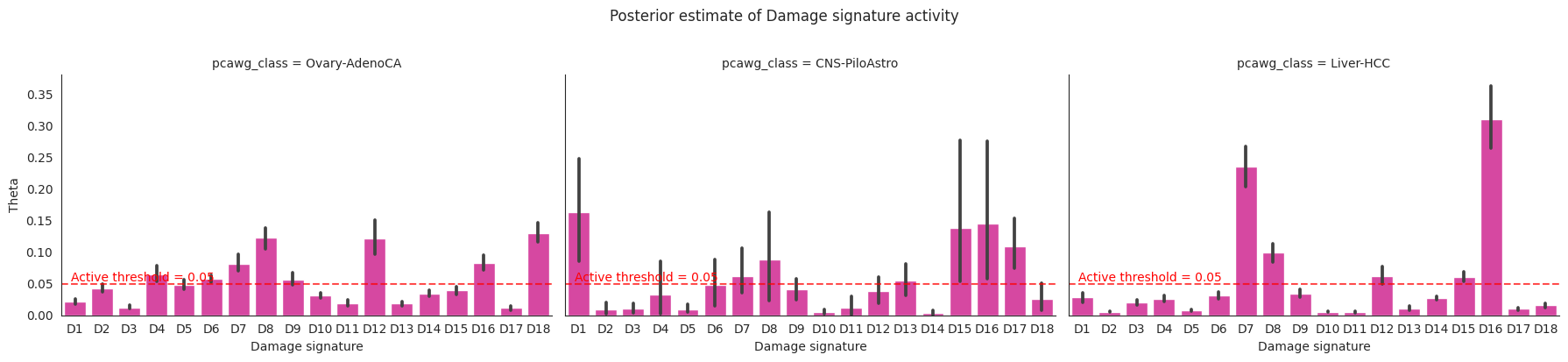
Now plot the activities and uncertainty!
[20]:
g = sns.FacetGrid(theta_df, col='pcawg_class', col_wrap=3, height=4, aspect=1.5)
g.map_dataframe(sns.barplot, x='Damage signature', y='theta', color = '#EE30A7')
g.fig.suptitle('Posterior estimate of Damage signature activity', y=1.02)
g.set_axis_labels('Damage signature', 'Theta')
for ax in g.axes.flat:
    ax.text(2.5, 0.05, 'Active threshold = 0.05', ha='center', va='bottom', fontsize=10, color='red')
    ax.axhline(y=0.05, color='red', linestyle='--', alpha=0.7)
plt.tight_layout()
plt.show()
[21]:
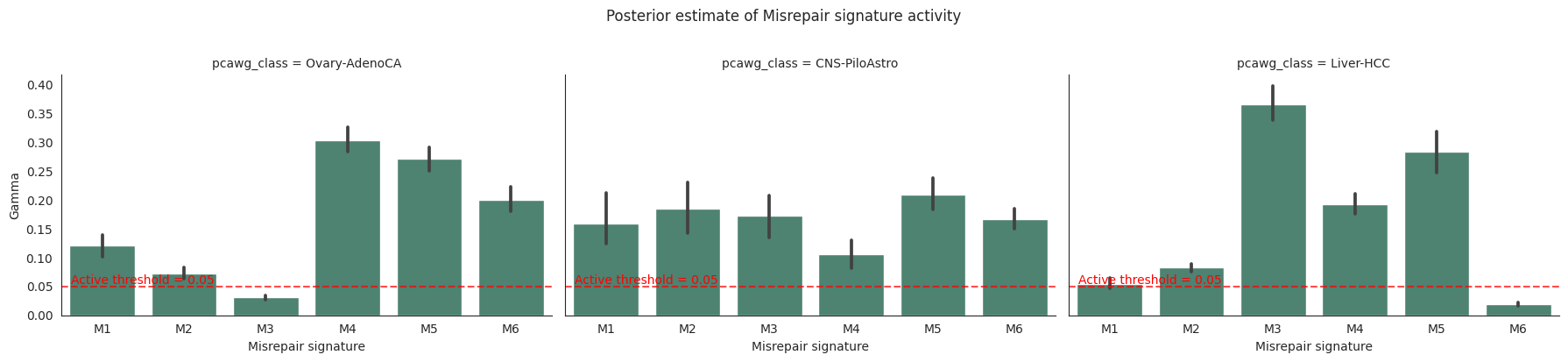
g = sns.FacetGrid(gamma_df, col='pcawg_class', col_wrap=3, height=4, aspect=1.5)
g.map_dataframe(sns.barplot, x='Misrepair signature', y='gamma', color = '#458B74')
g.fig.suptitle('Posterior estimate of Misrepair signature activity', y=1.02)
g.set_axis_labels('Misrepair signature', 'Gamma')
for ax in g.axes.flat:
    ax.text(0.5, 0.05, 'Active threshold = 0.05', ha='center', va='bottom', fontsize=10, color='red')
    ax.axhline(y=0.05, color='red', linestyle='--', alpha=0.7)
plt.tight_layout()
plt.show()