De-novo signature inference and activity estimation
[44]:
import pymc3 as pm
import arviz as az
import numpy as np
import pandas as pd
import damuta as da
import seaborn as sns
import matplotlib.pyplot as plt
from damuta.plotting import plot_damage_signatures, plot_misrepair_signatures
[45]:
# Load data for 100 patients
counts = pd.read_csv('example_data/pcawg_counts.csv', index_col=0).head(100)
annotation = pd.read_csv('example_data/pcawg_cancer_types.csv', index_col=0).head(100)
pcawg = da.DataSet(counts, annotation)
When there is no fixed signature definition provided, DAMUTA will estimate parameters for both the signature activities, and the signature definitions themselves.
We can help regularize this by putting strong sparsity priors on the distributions of the signature definitions (pi, lambda) and on the activity distributions (psi, priors on gamma)
[46]:
ht_lda = da.models.HierarchicalTandemLda(pcawg, type_col = 'pcawg_class', n_damage_sigs = 5, n_misrepair_sigs = 3)
ht_lda._build_model(**ht_lda._model_kwargs)
[47]:
ht_lda.fit(n=10000)
Interrupted at 6,931 [69%]: Average Loss = 1.3702e+06
[47]:
<damuta.models.HierarchicalTandemLda at 0x2ba4c8c70c70>
Check ELBO for convergence
[23]:
plt.plot(ht_lda.approx.hist)
[23]:
[<matplotlib.lines.Line2D at 0x2ba4b83cdbe0>]
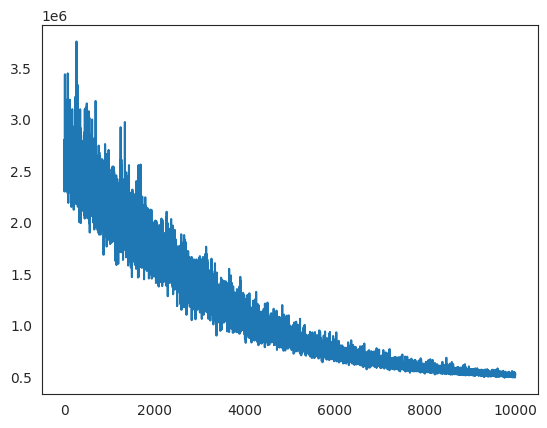
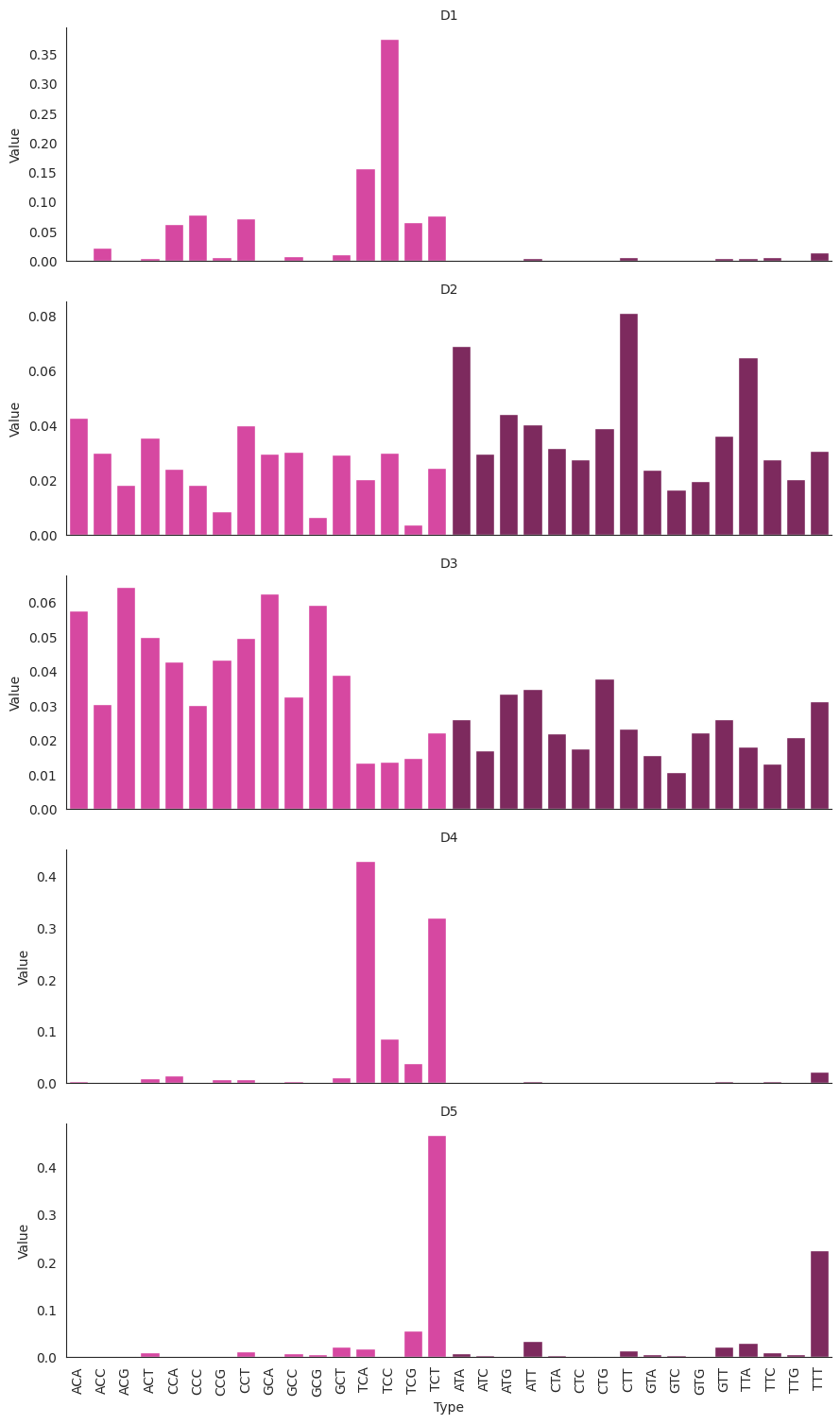
Let’s have a look at the inferred signature definitions. These have been estimated from only 100 samples for demonstration purposes.
[24]:
denovo_sigs = ht_lda.get_estimated_SignatureSet()
Damage signatures
[ ]:
plot_damage_signatures(denovo_sigs.damage_signatures)
<seaborn.axisgrid.FacetGrid at 0x2ba4ac58faf0>
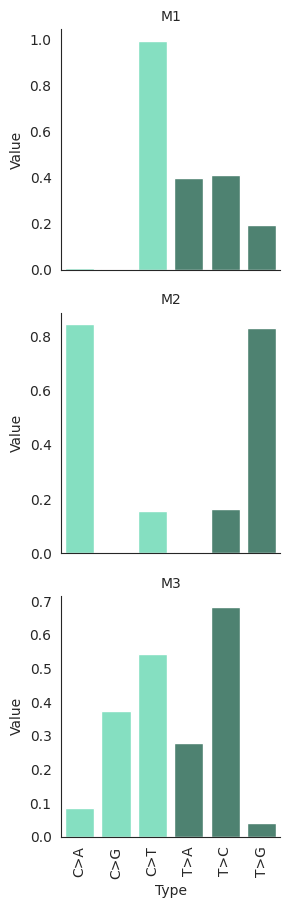
Misrepair signatures
nb. there are only six substitution classes - this means that you probably don’t ever need more than six misrepair signautres in your model
[26]:
plot_misrepair_signatures(denovo_sigs.misrepair_signatures)
[26]:
<seaborn.axisgrid.FacetGrid at 0x2ba4badd0310>
Options for initializing signatures
Uniformly at random
From k-means of the data: preferred for speed + stability
From a signature set: this will encourage signatures to be similar to the set, but not fix them in the model, meaning the definitions are allowed to drift over the course of training. In contrast to the example in quickstart, where signature definitions are fixed.
How many signatures to fit?
You can use BIC for model selection. More signautres will usually give a higher likelihood, and BIC penalizes adding these extra parameters.
We use the product of multinomial likelihoods to get the total probability of mutation counts in the dataset; when there are many samples this will be a very small number (large negative log value)
[38]:
trace = ht_lda.approx.sample(3)  # Sample from posterior
log_likelihood = np.array(list(da.utils.mult_ll(pcawg.counts, b) for b in trace.B)).sum(1).mean()
print(round(log_likelihood, 2))
print("for 100 samples, this is a log likelihood of approx.", round(log_likelihood/100, 2), "per sample")
-518178.83
for 100 samples, this is a log likelihood of approx. -5181.79 per sample
[40]:
BIC = ht_lda.model.ndim * np.log(pcawg.n_samples) - 2 * log_likelihood  # BIC calculation
print(round(BIC, 2))
1048432.43